The Story of Ted Topham
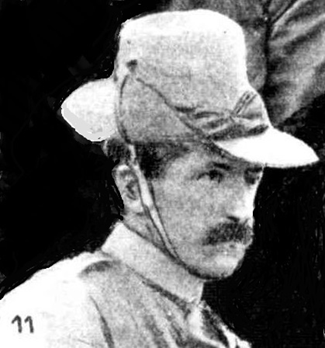
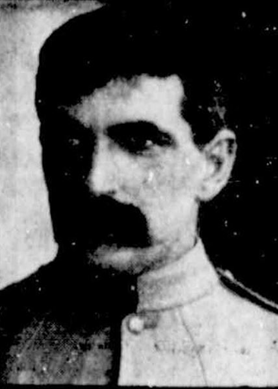
Ted Topham as he was known was the son of Bob Topham and Eliza Allanson from Yorkshire U.K. Ted was born on Low Mowthorpe Farm in Northern Yorkshire in 1863. His birthplace was meticulously surveyed and documented by agents of King William the Conqueror for Taxation purposes back in 1086.
This was part of the Great Survey of King William's English Kingdom. It is listed in The Doomsday Book.
Ted's family plus a few relations had migrated to Australia and New Zealand. It was not just to seek better opportunities in the antipodes. This was their chance to escape an English Doomsday Book Taxation legacy.
Ted was a boundary rider in Northern Victoria when he understated his age in order to enlist. He was a good horseman who could ride and shoot, so made the cut.
Ted was not married. His parents had predeceased him by then. Ted was four years older than the age he stated in order to enlist. He would have been seen as too old if he had stated his actual age. Ted was patriotic. However, he likely wanted adventure as well as the chance to escape from his mundane work.
Ted saw it was his duty to fight for his sovereign. The Queen and Empress Victoria. However, he was only a Soldier of the Queen for the last six days of her Epic Reign. For then King Edward VII ascended the throne.
Ted embarked from Port Melbourne on 8 Feb 1901 with the 5th Victorian Mounted Rifles. His unit was the last Colonial Boer War Mounted Contingent to be raised in Victoria. Federation meant that Defense was ceded to the Commonwealth. Hence later Boer War mounted units were raised as Commonwealth Horse Battalions.
Ted campaigned in Cape Colony then Orange Free State and in the Transvaal. The Boers attacked 5VMR's encampment on Wilmansrust Farm in the Transvaal on 12 June 1901. Ted was one of seventeen 5VMR NCO's and men who were KIA along with the 5VMR Surgeon.
Five Officers plus 36 NCO's and men were wounded in addition to those 18 KIA. Ted's unit, 5VMR, had suffered the heaviest casualties sustained by any of our Australian Boer War Contingents. That toll came from just one action. The Boers Commandos had made a successful night attack.
This became known as the 'Wilmansrust incident'. That in turn resulted in a heated enquiry. This event then became a matter of honour for the surviving 5VMR soldiers' reputations. British Army Generals were scathing of how the Fifth Victorian Mounted Rifles had failed to counterattack at Wilmansrust.
These Generals were Regular Cavalry Officers. That included the column's commanding General. He saw 5VMR Troops as little more than raw recruits. Further, 5VMR Officers were blamed because Troops had stacked their rifles outside their Bell tents. Hence did not have ready access to their rifles when Boer Commandos launched a surprise night attack.
Likewise, Generals were scathing about how 5VMR pickets were positioned. The duty of a picket was to provide an early warning of an unexpected attack. That will then rouse their encampment for battle stations.
Hence when the Boers attacked 5VMR's encampment that night, Ted and his mates did not have immediate access to their rifles. They were bedded down for the night in their Bell tents when that nighttime attack began. For it had been a long day's ride for these mounted troopers.
They were likely unarmed. Many fell trying to get from their bivouac tents to their neatly stacked rifles.
The Generals convened a Court of Enquiry three days after Ted and his comrades died. This court established that it was the British O.I.C. who had selected the Wilmansrust encampment on 12 June 1901, and then had ordered 5VMR to stack their arms. Rifles were stacked some distance from 5VMR Bell Tents. This Artillery Officer had selected and positioned his 5VMR pickets to protect his pom pom guns. MAJOR Morris RFA (Royal Field Artillery) was censured for his Command at Wilmansrust on that fatal day for Ted according to the Australian Boer War Memorial narrative.
Three of Ted's 5VMR comrades who refused to take the blame for their units stacked arms debacle were court martialed for inciting mutiny. In practical terms this was merely soldiers grumbling about British Officers.
It was overheard by a subaltern who construed it as inciting a mutiny. Three of Ted's 5VMR comrades were tried, convicted and sentenced to death. Lord Kitchener however exercised his power as the commanding General to either confirm or commute a death sentence. Cited from Australian Boer War Memorial "Wilmansrust Incident 12 June 1901".
Lord Kitchener commuted three death sentences on this occasion to penal servitude. He likely knew from his own vast experience that this was about disgruntled soldiers in the ranks grumbling. However, he had to enforce discipline in 5VMR for the sake of example. That was his duty as he saw it. Ten years imprisonment was the maximum term that he imposed on Ted's mates when he downgraded their death sentences. per the above "Wilmansrust incident 12 June 1901" citation.
The Australian Light Horse Studies Centre reports that the "Wilmansrust Mutineers" had been charged and convicted under the wrong section of the British Army Act. Hence Ted's three 'mutinous' comrades could not be shot. Their convictions were unsafe. The 5VMR 'mutineers' who had served with Ted were acquitted.
Hence all were released from British prisons and repatriated. However, the legal process it did take an appeal made directly to HM King Edward VII.
British High Command and their Regular Officers did not forget the ill-disciplined Australian irregulars.
Regardless of how well these Colonials fought, they were under British command. Hence subject to the Army Act. This incident was a foretaste of the Breaker Morant case where Australians sentenced under the Army Act were shot at dawn. However, it has to be stated that the Breaker Morant case was in a different league than this frivolous Wilmansrust Mutineer case.
Ted and his seventeen fallen 5VMR comrades were first buried in a communal grave on Wilmansrust Farm. They were later reinterred in the Old Middleburg Cemetery.
Ted Topham was a member of the Mildura Working Man's Club. He had spent many an hour in the reading room trying to educate himself because of his lack of formal schooling. From there he had access to books and newspapers.
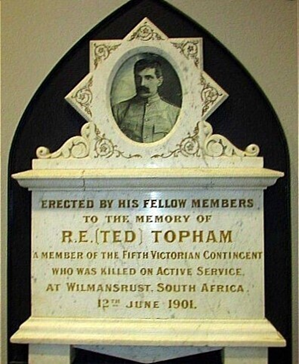
The Mildura Working Man's Club erected a marble tablet in the Reading Room on the first anniversary of his 1901 death. It was dedicated on 14 June 1902.
That was where Ted tried to educate himself. He would have read about epic events in other parts of the British Empire. Ted would see that as a more fitting legacy that he gave on the veldt. For it might inspire working men to be well-read and do their bit for the Empire.
References:
- "A Matter of Honour" - 5VMR in the Boer War (2017) page 471 bio sketch cited plus pages 127-130 entitled "Mutiny in the Ranks?"
- "Wilmansrust Incident 12 June 1901" details likewise cited from the Australian Boer War Memorial website.
- Australian Light Horse Studies Centre "Wilmansrust Mutineers" cited.